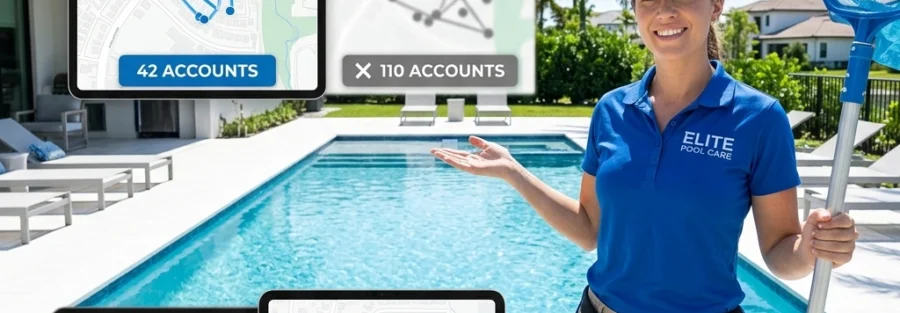
Are you currently staring at your customer list and wondering if you’ve built a gold mine or a money pit? Have you ever looked at a competitor with 150 accounts and felt a pang of jealousy, even though your 75-pool route seems to leave you with more energy at the end of the day? If you’re thinking, “It’s finally time to sell my pool route,” you might be surprised to learn that the "big" number isn't always the "profitable" number.
In the world of pool service, size isn't everything. As we navigate the shimmering waters of the 2026 market, the secret to a high-ticket exit isn't just about how many stops you have on your app: it’s about how close those stops are to one another. At Sealey Business Brokers, we’ve been in your shoes as former pool service company owners. We know that while a massive account count looks great on a business card, it’s route density that actually keeps your business afloat.
The Vanity Metric Trap: Why Account Count Can Be Deceptive
It’s easy to get caught up in the numbers. When someone asks how the business is doing, the knee-double response is usually, "Great, we just hit 100 accounts!" But as an expert pool route broker, I can tell you that 100 accounts spread across three counties is a logistical nightmare, not a lucrative asset.
Think of it this way: if you have 100 pools but your technicians are spending 45 minutes driving between each stop, you aren’t running a pool business: you’re running a trucking company that happens to clean water. Those "windshield hours" are the silent killers of your pool route valuation. They eat into your labor margins, spike your fuel costs, and increase the wear and tear on your fleet.
When a savvy buyer looks at your business, they aren't just looking at the total Monthly Recurring Revenue (MRR). They are looking at the net profit left over after the trucks are parked. A dense route is a resilient route.

Diving Into the Math of Density
Let’s pull back the curtain on how we evaluate routes here in May 2026. Imagine two different routes:
- Route A: 80 accounts, spread across a 40-mile radius.
- Route B: 60 accounts, all located within two adjacent zip codes.
On paper, Route A has more revenue. But when we look at the "hidden" costs, Route B is almost always the winner. Why?
- Fuel Efficiency: In 2026, fuel prices haven't exactly been kind to the service industry. Route B uses 40% less gas to generate its revenue.
- Labor Optimization: A tech on Route B can service two extra pools per day simply because they aren't stuck in traffic. That’s pure profit.
- Customer Retention: When your tech is "the neighborhood pool guy," they are more visible. Word-of-mouth marketing happens naturally when your trucks are seen on the same three streets every Tuesday.
When you ask how to sell a pool route for top dollar, the answer always starts with showing the buyer how much time they won't spend on the road. High density means higher margins, and higher margins mean a higher multiple during the valuation process.
The 2026 Market Shift: Why Buyers Crave Efficiency
The 2026 economy has shifted the way buyers look at acquisitions. Investors are no longer just looking for "growth at all costs." They are looking for "sustainable, efficient cash flow." With labor being the linchpin of any successful service business, any route that maximizes a technician's time is going to sell faster than a leaky filter on a Texas summer day.
As a specialized pool route broker, we’ve seen a trend where buyers are willing to pay a premium for "tight" routes. They see these as "plug-and-play" systems. If a buyer can take over your route and immediately see that their staff can handle the workload without burnout, you’ve just made their decision a whole lot easier.
If you're curious about how your specific geography stacks up, you can check out our resources to see how we analyze market trends across the country.

Strategic Positioning: How to "Tighten" Your Route Before Selling
If you’re planning to sell my pool route in the next 6 to 12 months, now is the time to start pruning the edges. It might feel counterintuitive to let go of customers, but "dropping the outliers" can actually increase your business's total value.
Here is a quick framework for building a sellable, dense system:
- Audit Your Geography: Map out every single account. Identify the "lone wolves": those accounts that are 15+ minutes away from your core clusters.
- The Profitability Test: Calculate the drive time vs. the monthly rate for those outliers. Are they actually making you money, or are they just "vanity" accounts?
- Trade or Sell Off the Outliers: Reach out to other local companies. Sometimes, your outlier is right in their backyard. Trading accounts or selling small chunks of your route can help you consolidate your footprint.
- Targeted Marketing: If you need to replace those lost accounts, focus your marketing only on the neighborhoods where you already have 3 or more pools.
By narrowing your focus, you aren't shrinking: you're specializing. This strategic positioning makes your business an "E-2 Visa" friendly or "absentee-owner" friendly investment, which opens the door to a wider pool of buyers. You can learn more about how we help international buyers in our E-2 Visa section.
Valuation Secrets: The Sealey Multiplier
Standard industry advice says a pool route is worth a certain "multiple" of its monthly billing. But we believe that's an oversimplification. At Sealey Business Brokers, our pool route valuation process takes a deep dive into the quality of your accounts.
A dense route with a hybrid billing model (where chemicals are billed separately or via a surcharge) is the "Goldilocks" of the industry. It’s just right. When we represent a seller, we highlight the "Minutes Per Stop" metric. If we can prove to a buyer that your route allows for 10 stops a day with only 45 minutes of total drive time, we can often push for a higher multiple than the local average.
We’ve helped owners across the country, from our Arizona routes to our listings in other states, realize that their most valuable asset wasn't the number of customers, but the concentration of them.

Is Your Pricing Model Holding You Back?
Density is the king, but pricing is the queen. In 2026, if you are still charging a flat rate that includes all chemicals regardless of the pool's size or the weather, you are leaving money on the table: and lowering your valuation.
Buyers want to see that you’ve protected your margins against inflation. A dense route combined with a smart, variable pricing model is a powerhouse. It shows that you aren't just a "tech with a truck," but a sophisticated business owner who has built a "sellable" system. This is a core part of the proven framework we teach our clients.
Anchoring Your Enterprise for a Successful Exit
Selling your business is a major milestone: it’s the culmination of years of sun-soaked days, chemical spills, and customer calls. You deserve to get the full value for the "sun-soaked tapestry" of work you’ve created.
Don't let a scattered route hold you back from the retirement or new venture you’ve been dreaming of. By focusing on density, you aren't just making your life easier today; you’re "anchoring your enterprise" for a lucrative exit tomorrow.
If you’re ready to take the plunge and find out what your route is truly worth in today’s market, we’re here to help. We aren't just brokers; we’ve lived the life. We know what it takes to build, run, and sell a successful pool service company.
Ready to see the real numbers? Contact us today for a confidential valuation and let’s see if we can turn your route into a rewarding investment for the next owner: and a massive win for you.
Want more tips on maximizing your business value? Join our newsletter to stay updated on the 2026 pool industry trends.