Are you ready to take the plunge and sell your pool route, but you’re staring at your account list wondering what it’s actually worth? If you’ve spent years skimming leaves and balancing chemistry under the Florida sun, you’ve likely built a sun-soaked tapestry of loyal clients. But when it comes time to anchor your enterprise and prepare for a lucrative exit, many owners make a common mistake: they focus purely on the number of accounts.
At Sealey Business Brokers, we’ve walked in your boots: and your pool shoes. As former pool service company owners ourselves, we know that 100 accounts spread across three counties is a logistical nightmare, while 50 accounts clustered in two zip codes is a goldmine. If you are thinking, "I want to sell my pool route for top dollar," you need to understand the hidden mechanics of pool route valuation.
Today, we’re revealing the secrets of why density matters more than account count and how you can use this knowledge to ensure your business makes a massive splash in the 2026 market.
The Mirage of the "Big" Route
It’s easy to get caught up in the vanity metrics. Having 200 accounts sounds impressive at a backyard BBQ, but in the world of professional brokerage, it’s just one piece of the puzzle. Imagine two businesses:
- Business A: 120 accounts spread across a 40-mile radius.
- Business B: 80 accounts all located within three adjacent gated communities.
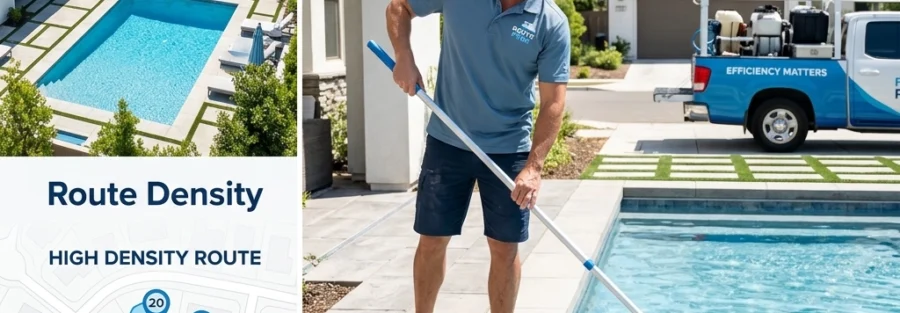
On paper, Business A has more revenue. But Business B is almost certainly more valuable. Why? Because Business A is spending a fortune on "windshield time": that unproductive gap between pools where you’re paying for gas, truck maintenance, and a technician's hourly wage to sit in traffic. Business B, however, has achieved route density, the holy grail of pool service efficiency.
When you look at how to sell a pool route, you have to look through the eyes of a buyer. A buyer isn't just buying your revenue; they are buying your profitability and the ease of operation.

Cracking the Code: The Pool Route Valuation Formula
In the current 2026 market, pool route valuation is generally calculated using a multiple of your Monthly Recurring Revenue (MRR). Typically, we see routes trading anywhere from 6 to 12 times their monthly service billing.
However, that multiplier isn't a fixed number. It’s a sliding scale based on the quality of the route.
- The 6x Multiplier: Often reserved for "starter routes" or those with high churn, poor documentation, or: you guessed it: terrible density.
- The 10x-12x Multiplier: This is where the "premium" routes live. These are the businesses with high-profit margins, modern billing systems, and tight geographic clusters.
If you want to move your business from a 7x to an 11x multiple, you don't necessarily need more accounts; you need better positioning of the accounts you already have. By tightening your route, you are effectively increasing the net income of every hour worked.
Windshield Time: The Profit Killer
Navigating uncharted waters in a new service area might seem like a great way to grow, but it often leads to "profit leaks." Every mile your truck travels between stops is a mile where you are losing money.
In 2026, with fluctuating fuel costs and the rising price of vehicle maintenance, density has become a linchpin of a sellable system. A dense route allows a single technician to service more pools per day with less fatigue. This leads to higher employee retention: another factor that a pool route broker will highlight to potential buyers.
When a buyer sees a route where a tech can hit 12 pools a day because they are all in the same neighborhood, they see a resilient, high-margin investment. They see a business that is "turnkey."
How to Increase Your Density Before You Sell
If you’re looking at your map and realizing your accounts look more like a game of connect-the-dots gone wrong, don’t panic. There are strategic steps you can take to "clean up" your route before you put it on the market.
- The "Pruning" Method: It sounds counterintuitive, but sometimes you have to lose accounts to make more money. If you have three accounts that are 20 minutes away from the rest of your route, consider selling those specific accounts to a competitor or simply letting them go. The time and fuel saved can be reallocated to marketing in your "core" area.
- Targeted Marketing: Use your current dense clusters as a base. Run door-hanger campaigns or targeted social media ads specifically for the neighborhoods where you already have a presence. Adding a neighbor to an existing street is 100% profit compared to driving across town.
- Referral Programs: Encourage your best clients in your tightest routes to refer their neighbors. A "one month free" incentive is a small price to pay for a lifetime of route density.
For more on preparing your business for a transition, check out our strategy category for deep dives into operational excellence.

Visualizing Success: Using Data to Prove Value
When you decide to sell my pool route, you need to provide more than just a list of names and addresses. Modern buyers are savvy. They want to see the data.
One of the most effective ways to prove density is through GPS mapping and heat maps. At Sealey Business Brokers, we help our clients visualize their routes for potential buyers. When a buyer can see a "heat map" where 90% of your revenue is concentrated in a 5-mile radius, the perceived risk of the investment drops significantly.
This kind of transparency builds immediate trust. It shows that you aren't just a guy with a pole and a truck; you are a business owner with a strategic grip on your operations. This is the difference between a "job for sale" and a "business for sale."
Why a Specialized Pool Route Broker Matters
The pool industry is unique. Traditional business brokers often don't understand the nuances of weather patterns, chemical spikes, or the sheer value of a tight route. They might try to value your business based on EBITDA alone, missing the inherent value of the recurring revenue and geographic density.
As a specialized pool route broker, Arif Sealey and the team at Sealey Business Brokers understand the "shimmering water" of this industry. We know how to highlight your route's strengths, whether it's your hybrid billing model or your incredible density. We’ve helped owners like Joe and Ruth navigate these waters to find the perfect buyer.
The 2026 Shift: Why Now is the Time
The market in 2026 is seeing a surge in "lifestyle buyers": individuals looking for stable, recession-resistant businesses that offer a balance of outdoor work and professional management. These buyers are specifically looking for routes that won't require them to spend 4 hours a day in a truck.
By focusing on density now, you are making your business the most attractive "house on the block." You are creating a rewarding opportunity for someone else to step into, while ensuring you walk away with the maximum possible return on your hard work.
Taking the Next Step
Selling your business is a journey, and every journey needs a map. If you are feeling overwhelmed by the technicalities of pool route valuation, remember that you don't have to navigate these uncharted waters alone.
Whether you’re just starting to think about an exit or you’re ready to list today, understanding that density is the heartbeat of your valuation is the first step toward a successful sale. Don't let your hard-earned profits evaporate in "windshield time." Tighten those routes, document your efficiency, and prepare to make a splash.
Are you curious about what your specific route is worth in today's market? Don't leave your legacy to chance. Contact us today for a professional consultation. Let’s work together to show the world the true value of what you’ve built.
Your shimmering future is waiting( let's dive in.)