Are you ready to make a splash in the market and finally sell my pool route for what it’s actually worth? Or perhaps you’re just starting to navigate the uncharted waters of business brokerage, wondering if your "account count" is the golden ticket to a lucrative retirement.
In the world of pool service, there is a common myth that floats around every trade show and supply house: the more accounts you have, the more your business is worth. But here’s the cold, hard truth that most brokers won’t tell you: a massive, scattered list of accounts can actually be a hidden drain on your valuation.
At Sealey Business Brokers, we’ve been in your shoes. We haven't just sold routes; we’ve owned and operated a pool service company ourselves. We know that the real "secret sauce" to a high-value exit isn't just the number of stops on your manifest: it’s the density of those stops.
The Illusion of the "Big Number"
When owners ask how to sell a pool route, they often lead with, "I have 100 accounts." While 100 accounts sound impressive, a savvy pool route broker (and any serious buyer) will immediately look beneath the surface.
Imagine two different routes:
- Route A: 100 accounts spread across three different counties.
- Route B: 75 accounts all located within two adjacent zip codes.
On paper, Route A has more "volume." But in reality, Route B is a resilient, high-margin machine. Why? Because density is the linchpin of profitability. When your accounts are clustered together, your technicians spend more time with their hands in the water and less time with their feet on the gas pedal.

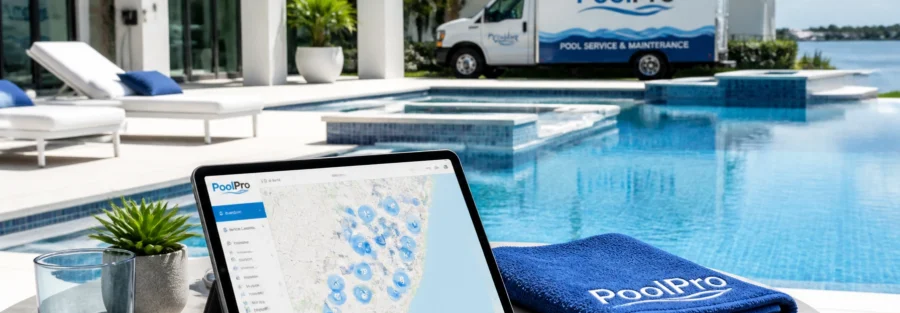
(Note: Visualizing a tight cluster of stops reveals the true efficiency of your business.)
Why Density is the True Driver of Pool Route Valuation
When we perform a pool route valuation, we don't just use a "one-size-fits-all" multiplier. While the industry standard often hovers between 8x to 12x monthly billing, a dense route is what pushes you toward that "blue-ribbon" 12x (or higher) multiple.
1. The "Windshield Time" Tax
Every minute your truck is in transit is a minute you are paying for labor, fuel, and vehicle wear-and-tear without generating a cent of revenue. This is what we call "windshield time."
A dense route minimizes this tax. If your tech can service 12 pools in a single neighborhood versus 8 pools scattered across town, the math is undeniable. You are capturing more revenue per hour, which directly pads your bottom line. To a buyer, this isn't just a convenience; it’s a solid investment in their future margins.
2. Operational Resilience
Dense routes are simply easier to manage. If a truck breaks down or a technician calls in sick, it is much easier for a supervisor to "pivot" and cover a tight cluster of pools. Navigating the logistics of a scattered route is like trying to anchor your enterprise in a storm: everything is harder, riskier, and more expensive.
3. Technician Retention
In 2026, finding and keeping good help is more challenging than ever. Technicians love dense routes. They finish their days earlier, they drive less, and they feel more productive. When you sell my pool route, you aren't just selling customers; you are selling a "sellable" system. A happy, stable team is a massive asset to any buyer.
How to "Tighten the Ship" Before You Sell
If you’re thinking about how to sell a pool route in the near future, you don't have to settle for your current density. You can take proactive steps to trim the fat and boost your valuation before we even list your business.
Prune the Outliers
It sounds counterintuitive, but sometimes the best way to increase your business's value is to let go of your furthest accounts. That one customer who lives 20 miles away might pay well, but the logistical cost of servicing them is likely eating the profit of three other pools. By dropping outliers, you create a "cleaner" asset that buyers will pay a premium for.
Strategic Price Hikes
If you have accounts that are outside your core density zone, ensure they are paying a "distance premium." If they won't pay it, you've identified an account that is ready to be pruned. This ensures your pricing model reflects the reality of 2026 operating costs.
Use the "Neighbor Effect"
Encourage your techs to leave door hangers or offer "neighbor discounts" in your densest neighborhoods. Filling the gaps in an existing street is the fastest way to turn a "good" route into a "great" one.
The Sealey Advantage: Why We See What Others Miss
Most brokers just look at your Profit & Loss statement and your customer list. At Sealey Business Brokers, we dive deeper. Because we’ve been in the trenches, we know how to strategic positioning your route to highlight its efficiency.
We know that a buyer who is moving out of real estate investments or looking for a career change is looking for predictability. They want a business where the numbers make sense, and nothing makes more sense than a high-density route.
We maintain a high success rate: selling over 90% of our listings: because we don't just list your business; we guide you through the process. From ensuring personal attention to offering free escrow and quick closings, we make the transition as smooth as a glass-like pool surface at dawn.
Taking the Plunge: Your Next Steps
Is your route a shimmering tapestry of efficiency, or is it a fragmented mess that’s costing you money? Don't wait until you're burnt out to find out.
If you are ready to unlock the secrets of your specific pool route valuation, it’s time to talk to an expert who speaks your language. Whether you're in Arizona or anywhere nationwide, we are here to help you navigate these waters.
Don't let your hard work evaporate.
Click here to get a free valuation and start your journey toward a successful exit today.
Frequently Asked Questions
Q: Does a higher account count ever justify a lower density?
A: Rarely. While a larger volume can be attractive for "scaling," the operational headaches usually lead to a lower multiple. A buyer would much rather buy two dense routes than one massive, scattered one.
Q: How do I know if my route is "dense enough"?
A: A good rule of thumb is looking at your "stop-to-stop" drive time. If your average drive time between accounts is over 15 minutes, you have a density problem that could be dragging down your valuation.
Q: Can a pool route broker help me fix my density before I sell?
A: Absolutely. At Sealey, we offer personalized service to help you "clean up" your route so it’s ready for a premium sale. We’re not just here to sell; we’re here to help you win.
