Are you currently treading water, wondering why your hard work isn't translating into a higher exit price for your business? You’ve spent years under the sun, keeping chemicals balanced and filters clean, but when it comes time to sell my pool route, you might find that the numbers on your spreadsheet don’t tell the whole story.
At Sealey Business Brokers, we’ve been exactly where you are. As former pool service company owners ourselves, we know the difference between a route that looks good on paper and one that actually puts money in your pocket. Today, we’re pulling back the curtain on the industry’s biggest open secret: why route density is the absolute linchpin of your pool route valuation.
The Vanity Metric: Why "More Accounts" Can Be a Trap
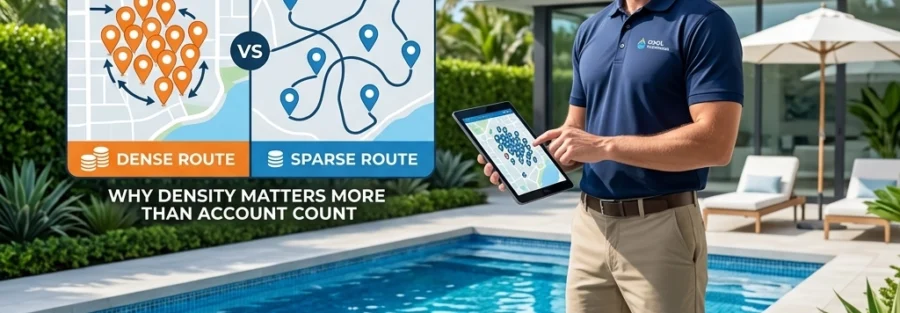
It’s a common ambition to want to reach that "100-stop" milestone. It feels like a badge of honor. But if those 100 stops are scattered across a 50-mile radius, you aren’t running an efficient business; you’re running a high-stress logistics company that happens to clean pools.
When you decide it's time to learn how to sell a pool route, the first thing a sophisticated buyer (or a seasoned pool route broker) will look at isn't just the total number of accounts. They are looking at the "windshield time."
Think of it this way: Every minute your truck is in motion is a minute you are paying for fuel, maintenance, and labor without generating a cent of revenue. A route with 60 pools clustered in two tight neighborhoods is often worth significantly more than a route with 90 pools spread across three different zip codes.

The Valuation Formula: Beyond the Multiplier
In the world of pool service, the standard valuation formula has traditionally been Monthly Recurring Revenue (MRR) multiplied by a factor of 8 to 12.
However, as we move through 2026, the market has become much more nuanced. A "starter route" with low density might only fetch a 6x or 7x multiplier because the buyer knows they’ll be spending a fortune on gas and truck repairs. On the flip side, a "premium route" with high density can easily command a 12x to 15x multiplier: or even higher in hot markets like Florida or Arizona.
If you’re looking to maximize your pool route valuation, you need to understand the "Hidden Value Drivers":
- Stop Proximity: Can your technician service 10 pools without moving the truck more than twice? That is a gold mine.
- Profit Margin per Stop: High density naturally lowers your overhead, making your "net" much more attractive to buyers.
- Predictability: Clustered routes are easier to manage, easier to train for, and easier to sell.
Why Density is the Ultimate Hedge Against Inflation
In April 2026, we are seeing that efficiency isn't just a "nice-to-have": it's a survival mechanism. With the costs of pool chemicals and vehicle maintenance remaining volatile, a dense route acts as a buffer.
When your accounts are tight, a 10% increase in fuel costs barely ripples your bottom line. But if your technician is driving 40 miles between stops, that same fuel hike can eat your entire profit margin for the day. Buyers know this. They aren't just buying your revenue; they are buying your resilience.
If you want to see how your current route stacks up, you can check out some of our current listings to see what high-density routes look like in the real world at our routes for sale page.
The "Neighborhood Takeover" Strategy
As former owners, we always recommend the "Neighborhood Takeover" strategy to anyone asking how to build a sellable system. Instead of chasing every lead that calls from across town, focus your marketing on the three-block radius where you already have five customers.
One of the best ways to boost your valuation before you sell your route is to spend six months aggressively densifying. Offer "neighbor discounts" or referral bonuses specifically to people on the same street. Turning a "loose" route into a "tight" one is the fastest way to add $20k, $50k, or even $100k to your final sale price.

Visualizing Success: Proving Your Density
A buyer isn't just going to take your word for it that your route is "tight." You need to show them. This is where modern tools come into play. Using GPS mapping software to create a visual "heat map" of your accounts is one of the most powerful moves you can make during the due diligence process.
When a buyer sees a map with clusters of dots rather than a constellation spread across the entire state, their confidence skyrockets. It proves that the business is a "plug-and-play" asset. At Sealey Business Brokers, we help our clients present this data in a way that highlights the strategic positioning of their accounts. You can learn more about our process on our about us page.
The Role of a Specialized Pool Route Broker
Navigating these waters can feel like trying to find a dropped O-ring in a dark pool. This is why having a specialized pool route broker is essential. General business brokers often don't understand the nuances of "rack rates," "plus-chems," or the massive impact of density on the bottom line.
We speak your language. We know that a route in a high-growth area like Richmond (check out our Richmond specific page) or a dense cluster in Florida (like our Pinellas listing) requires a different valuation approach than a rural route.
We don't just list your business; we help you "anchor your enterprise" by identifying the strengths in your route density and highlighting them to the right pool of buyers.
Making the Splash: Your Next Steps
If you’ve been thinking about taking the plunge and exiting the industry, don't just focus on getting "one more account." Focus on the right accounts.
Ask yourself:
- What is my average drive time between stops?
- Do I have neighborhoods where I am the "dominant" provider?
- How would a 20% increase in fuel costs impact my current route?
If the answers to those questions make you feel like you're sinking, it’s time to restructure before you list.

Strategic Positioning for 2026 and Beyond
The 2026 market is rewarding owners who have moved away from the "volume at all costs" mindset and toward a "profit per mile" strategy. High-density routes are the blue-chip stocks of the pool industry. They are reliable, they are efficient, and they are highly sought after by both individual buyers and private equity groups.
Whether you are looking for a great Venice area pool route or looking to sell a massive enterprise in Texas, the rules of density remain the same.
Final Thoughts from Arif Sealey
I’ve seen owners walk away with life-changing money because they spent two years focusing on density rather than just "more pools." On the flip side, I've seen guys with massive account counts struggle to sell because their overhead was a nightmare.
Don't let your hard-earned equity evaporate in the exhaust pipe of your service truck. Focus on the clusters, document your efficiency, and when you're ready to see what your business is truly worth, we’re here to help you navigate the process.
Ready to dive deeper? Check out our resources page for more tips on preparing your business for a lucrative exit, or contact us today for a confidential valuation.
Selling your pool route shouldn't feel like a marathon: it should feel like a victory lap. Let's make sure yours is.